A message from our Co-Managing Partners:
“Just weeks into the new year, we watched the inauguration of the current administration with a heaviness that many of us felt not just professionally, but personally. President Trump’s second term has been defined by its unapologetic hostility to people of color, LGBTQ+ individuals, and immigrants as well as its denigration of vulnerable communities across the country. That reality is sobering. But it also sharpens our sense of purpose and reminds us why this firm exists. Along with our community allies and partners, we’re called to advocate on behalf of those whose voices have too often been muted. Our role is more important than ever, particularly as many of our friends and counterparts in this work are being targeted for their speech and dedication to equality.
For more than 25 years as a firm, Relman Colfax has seen political shifts and discriminatory agendas come and go, and we’ve learned to recognize moments that demand more of us. This is one of those moments when we’ve had to hold fast and strengthen our resolve.
This year, we have witnessed exceptional dedication from our team. Their tireless advocacy and a commitment to the communities we serve has made progress truly possible. We are looking forward to seeing the ways they use their voice and voracity for justice in the coming year.
As 2026 approaches, we remain guided by the words of Congressman John Lewis, ‘A democracy cannot thrive where power remains unchecked and justice is reserved for a select few. Ignoring these cries and failing to respond to this movement is simply not an option — for peace cannot exist where justice is not served.’”
— Reed Colfax, Tara Ramchandani, and Stephen Hayes.

Sharing Information to Restore Power
We know that information is power, but when an administration deliberately floods the media and public with rapid-fire announcements, executive orders, and legal threats, confusion and exhaustion can take hold that can breed fear, overwhelm, apathy, and ultimately silence.
We believe it is our responsibility to disrupt these cycles by publishing reliable information about the rule of law and how to seek justice during these challenging times. That belief is what led us to launch a series of explainers this year, beginning almost immediately after the inauguration, to cut through the noise, answer urgent questions, and remind people of their rights.

Following President Trump’s inaugural speech, the administration issued executive orders threatening federal funding for hospitals and clinics providing gender-affirming care to transgender children and young adults. In response to these orders, several providers reduced or halted care out of fear of federal retaliation, despite continued protections under state law. Many families were left confused and without care. Recognizing the uncertainty facing patients and providers alike, Relman Colfax created an explainer, State Antidiscrimination Laws and Gender-Affirming Care in the Wake of the Trump Administration Executive Orders, to provide clarity and legal context.
As attorney Alexa Milton explained, “We believe that awareness and understanding of these laws is critical. Despite the Administration’s efforts to sow fear and confusion, the trans community remains protected under state law in many states. Ensuring these rights are both known and respected is a shared responsibility. This includes the medical community, state officials, and advocates working tirelessly on the ground.” In the months since the explainer was published, the Administration has only stepped up its efforts to coerce doctors, clinics, and hospitals into terminating this important care, and understanding these state law protections continues to be crucial.
Authored by Rebecca Livengood, Alexa Milton, and Megan Russo, the explainer reflects the firm’s steadfast commitment to defending the civil rights of the LGBTQIA+ community.
Alexa also spoke publicly about the administration’s broader attacks on LGBTQIA+ communities, including when all LGBTQ and HIV-related content has been removed from the White House's website, telling the Bay Area Reporter: ”The removal of these resources is yet another symptom of this administration's contempt for our communities. They want to overwhelm us with attacks in the hopes that we lose our footing, but it won't work. The administration may be able to delete these resources with the push of a button, but their posturing does not erase our hard-won freedoms – and we and many other advocates are ready to fight back to defend them.”

That same commitment to clarity guided our response to Executive Order 14281, signed on April 23, 2025, which targeted disparate impact. Disparate impact is a foundational principle of civil rights law recognized by courts, Congress, and the executive branch for decades. Questions quickly arose about whether the order altered the legal landscape in housing, credit, and employment.
In an explainer authored by Zachary Best and Stephen Hayes, we made the answer clear: the Executive Order has no immediate effect on disparate impact law.
EXECUTIVE ORDER ON DISPARATE IMPACT: AN EXPLAINER outlined that while federal agencies may attempt regulatory changes, such efforts will face serious legal challenges and take time to resolve. In the meantime, disparate impact remains the law, and institutions should continue their existing compliance efforts.
Stephen Hayes and Tara K. Ramchandani further expanded on this issue in separate pieces for New America, examining why disparate impact is both good for business and essential to addressing intentional housing discrimination. Read Stephen’s op-ed on why disparate impact is good for business and Tara’s op-ed on why it matters to tackle intentional housing discrimination.

This year we also addressed the administration’s attempt to weaponize the False Claims Act through our explainer authored by Zoila Hinson and Michael Allen. Following the Department of Justice’s announcement of its Civil Rights Fraud Initiative, the administration sought to intimidate colleges and universities, particularly Harvard, by claiming that equity and diversity efforts constituted fraud. The explainer underscores that this effort is legally baseless and urges institutions to resist intimidation.
Founding Partner John Relman reinforced this message in two op-eds: Trump’s Lawless Attack on Harvard Is Like None Before and Harvard Must Not Make a Deal With Trump.
In June 2025, the firm filed an amicus brief in President and Fellows of Harvard College v. United States Department of Health and Human Services, et al., challenging the administration’s unlawful termination of millions of dollars in federal funding without following required Title VI procedures. The Relman Colfax amicus team included Rebecca Livengood, Glenn Schlactus, and John Relman, with paralegal assistance from Jake Hogan.
Speaking to WGBH, John noted, “The attack on Harvard is part of a broader campaign against universities that the administration perceives as too woke, too liberal.”
And Harvard was right in resisting pressures to back down. On September 3, 2025, Judge Allison Burroughs ruled that the administration’s attempt to cut more than $2.2 billion in federal research funding violated the First Amendment, Title VI, and the Administrative Procedure Act, a resounding victory for Harvard and for the rule of law. As John Relman said afterward, “My hope is that this victory stiffens the spine of other universities and serves as a wake-up call for institutions that have been wavering or capitulating under political pressure.”

Finally, our explainer THE CAMPAIGN FOR ACCESSIBLE HOUSING, authored by Michael Allen and Tim Lambert, addresses a long-standing failure to enforce federal accessibility requirements under the Fair Housing Act. For decades, the law has required new multifamily housing to be accessible to people with disabilities, yet compliance often remains inadequate.
Working alongside local Centers for Independent Living and disability advocates, Relman Colfax continues to push for enforcement of these federal guarantees, ensuring that the promise of accessible housing is no longer deferred.
Speaking Out When Stakes Are At Their Highest

Relman Colfax stands ready to challenge entrenched discrimination and segregation throughout the nation. This year, we urged our fellow legal advocates to do the same. As attacks on the rule of law intensified, so too did the pressure on those sworn to defend it.
The legal profession itself came under assault in ways few could have imagined. President Donald Trump issued executive orders targeting three major law firms, openly retaliating against them for representing Democratic candidates and causes. That campaign escalated further with a sweeping memorandum threatening lawyers across the country with unspecified sanctions simply for challenging the president or his administration.
In response, we refused to remain silent. John Relman authored two op-eds, “Big Law Needs to Stand up to Trump” and “Big Law Is Winning in Court—Now Is Not the Time to Fold,” calling on the profession to meet intimidation with resolve.
The firm also joined more than 4,000 individuals and organizations in signing the letter “Stand Up for the Legal Profession — and the Rule of Law.” As the firm has made clear, intimidation only succeeds when it goes unanswered. “If law firms stand up for themselves and their clients, the campaign of intimidation can be shut down,” John stated.
Halting Cuts on Critical Housing Funds

This year began with the administration promising massive financial cuts through the short-lived Department of Government Efficiency (DOGE). With the goal of eliminating $2 trillion in federal spending, we witnessed unlawful attacks on critical fair housing funding. We launched into action by moving for a Temporary Restraining Order (TRO) against the U.S. Department of Housing and Urban Development (HUD) in March. In Massachusetts Fair Housing Center, et al. v. HUD and DOGE, Relman Colfax, alongside members of the National Fair Housing Alliance’s (NFHA) seeking to represent over 60 fair housing organizations, fought back against the abrupt and unjustified termination of grants under the Fair Housing Initiatives Program (FHIP).
The cuts, enacted without adequate explanation or legal authority by HUD and DOGE on February 27, 2025, placed often marginalized communities and the ongoing fight for housing equality at grave risk. The termination of those grants jeopardized over $30 million in critical, congressionally authorized funding for fair housing groups to fight housing discrimination and enforce fair housing laws throughout the country. This case was covered by The New York Times and NPR. The litigation team consisted of Reed Colfax, Zoila Hinson, Robert Hunter, Rebecca Livengood, Lila Miller, and Yiyang Wu.
In June, Relman Colfax filed a federal lawsuit on behalf of NFHA and the Tennessee Fair Housing Council (TFHC) challenging HUD’s unprecedented and unlawful refusal to administer critical grant funding under the Fair Housing Initiatives Program. NFHA et al. v. HUD et al. was filed in the United States District Court for the District of Columbia, and the case directly challenges the Administration’s failure to fund important federal housing enforcement. The litigation team consisted of Reed Colfax, Lila Miller, and Robert Hunter.
On July 28, 2025, the Court granted Plaintiffs’ Motion for a TRO. The motion sought to compel HUD to resume administration of the critical FHIP. With FHIP funds at risk of expiring by the end of the fiscal year, the Court recognized that delaying action would cause “imminent and irreparable harm.” The ruling, which was later converted into a preliminary injunction, marked an important step in protecting critical civil rights and housing infrastructure nationwide.
These cases reaffirm something essential: the fight for fair housing cannot be paused. Every day without funding costs families their homes, their safety, and their futures.
Supporting the Work of the Consumer Financial Protection Bureau

At the start of this year, Relman Colfax filed an amicus brief in the United States Court of Appeals for the Fifth Circuit on behalf of a coalition of lenders, nonprofits, and small business advocates in support of the Consumer Financial Protection Bureau’s (CFPB) 2023 small business data collection Final Rule under Dodd-Frank Section 1071. The brief, authored by Stephen Hayes and Sacha Markano-Stark, highlights the importance of 1071 data in ensuring transparency in small business lending, which will enable innovation, promote responsible practices, and discourage predatory behavior, including for women- and minority-owned businesses that have historically faced barriers in accessing credit.
In September, Relman Colfax filed an amicus brief in Rise Economy et al. v. Vought et al. supporting a legal challenge to the Trump Administration’s delays in implementing Dodd-Frank Section 1071. Small businesses are the backbone of the U.S. economy, but decades of inaction have left us without basic data on who gets loans and under what terms. The Relman Colfax team consisted of Stephen Hayes, Tim Lambert, and Soohyun Choi.
Throughout the year, the current administration has taken unprecedented actions to dismantle the CFPB, despite the fact that the agency has returned more than $21 billion back to consumers who have fallen victim to abusive and illegal activity. To date, the public has strongly supported the agency, and courts have repeatedly rejected industry attempts to neutralize it. Recently, for example, CFPB leadership announced that it plans to transfer its entire enforcement and legal divisions to the Department of Justice and the Bureau will furlough almost all of its staff in those units. In December, it proposed to eliminate critical anti-discrimination protections, that would mean women, people of color, older adults and others will find it harder and more expensive to access mortgages, small business loans, and other credit opportunities. The Firm worked closely with civil rights, consumer protection, and other organizations to submit comments opposing those changes, and will continue to fight against the CFPB’s unlawful actions to roll back civil rights protections.
It was also reported earlier this month that a group of Democratic state prosecutors hired the former director of the CFPB to lead an effort to address the risking cost of living and widespread fraud, focusing on health care, technology, and financial services. Bloomberg shared that Rohit Chopra, who frequently clashed with banks before his dismissal as CFPB Director in February, will lead the Consumer Protection and Affordability Working Group. “The creation of the affordability working group — operating within . . . the Progressive State Leaders Committee — is part of a broader strategy by state-level Democrats to reshape their image with voters,” commented John Relman.
Celebrating Civil Rights Successes

In 2025, we celebrated major civil rights victories with wide-reaching impact for our clients, their communities, and beyond.
This year, the Court of Appeals of Virginia issued a landmark decision affirming the right of Newport Academy to operate a small, licensed group home for young adults with mental health needs in Loudoun County. Relman Colfax successfully defended Newport, securing a clarifying interpretation of Virginia Code § 15.2-2291. While Virginia law has long required local governments to treat small, licensed group homes like traditional families, this marked the first time a Virginia appellate court addressed the statute in a contested case. The decision now provides critical guidance statewide and reinforces longstanding Fair Housing Act principles. The effort was led by Michael Allen.
This Spring, Relman Colfax announced a $525,000 settlement on behalf of the National Fair Housing Alliance and the Tennessee Fair Housing Council resolving accessibility complaints against Gross Residential involving thirteen apartment complexes across four states. Approved by HUD, the settlement requires extensive remediation to ensure accessibility, training on Fair Housing Act design requirements, independent compliance inspections, and adoption of a public compliance notice. The Relman Colfax team included Sara Pratt and Nicolas Abbott.
The firm secured final approval of a class action settlement in Puryear v. Dotson, a critical civil rights case challenging unlawful over-incarceration by the Virginia Department of Corrections. The settlement provides meaningful compensation to 52 class members. Individual awards range from $1,000 to over $50,000, with an average recovery of over $21,000. In addition to this, the court approved a $40,000 service award for named plaintiff Leslie Puryear, recognizing his leadership and courage in bringing the suit.
“Our hope is this settlement vindicates the constitutional rights of individuals who suffered weeks, months, and even over a year of unnecessary imprisonment,” said Rebecca Livengood. “We are deeply grateful to Mr. Puryear for coming forward, sharing his story, and pushing for accountability. His bravery made this result possible.”
The litigation was led by Rebecca Livengood and Ellora Israni.
Relman Colfax continues to fight for justice and stand up against housing discrimination in cases like Stanton Square LLC v. City of New Orleans, Lawrence County Recovery, LLC et al. v. Village of Coal Grove et al., Concern For Independent Living, Inc. v. Town of Southampton, New York, and Denton Housing Authority v. Providence Homeowners Association Inc. et. al. We are continuing to make meaningful progress in National Fair Housing Alliance, et al. v. Kelly, et al., challenging Florida’s xenophobic scheme to prevent people from owning land through SB264.
We are profoundly proud of what we have accomplished in 2025, and it is an honor to continue to do this work with our brave clients and allies.
Catching Up With Relman Colfax

Fighting for Fair Housing in Belton, MO

This month, Relman Colfax filed a complaint in the United States District Court Western District of Missouri on behalf of Belton Development, LP, Commons of Belton DVLPR, LLC, Jabal Companies, LLC, and Calvary University against the City of Belton, Missouri and Belton City Council for the unlawful prevention of the construction of the Commons of Belton, a multi-family affordable housing development.
In early 2024, the Plaintiffs, at the urging of City officials who recognized the need for more workforce housing in their community, began the pre-development process for building a 252-unit affordable housing apartment complex in the City of Belton, a predominantly white suburb of Kansas City. The proposed development would provide affordable units for the area’s lower income families and workforce, who are disproportionately Black and in significant need of affordable housing opportunities.
When starting discussions, the City recognized its substantial and growing need for affordable housing units to accommodate the expanding workforce. The Belton Planning Commission explicitly noted that the Commons might be the only project in the foreseeable future that could provide affordable workforce housing near the growing employment centers in and around the City. City officials and many Council members expressed their strong support, signing a letter of intent and a purchase option agreement for the City parcel where the Commons would be developed.
In addition to the significant resources invested to design the project, the Plaintiffs also contracted with Calvary University to purchase an adjoining parcel of land that, along with the City parcel, was necessary for the development of the project. As part of the sale of the University parcel, the Commons of Belton Plaintiffs also agreed to build the University a competitive soccer field that would allow the school to build its athletic program.
The Commons project was fully on track until the City’s support abruptly ended in response to the mobilization of a vocal minority of Belton residents who rallied against the development at the May 2025 Planning Commission and City Council meetings. The complaint alleges that the neighbor opposition was steeped in discriminatory rhetoric, making clear that these City residents did not want a disproportionate number of Black families and families with children moving into an affordable housing development in their neighborhood. The Planning Commission and City Council acceded to the discriminatory opposition and voted to deny the Commons’s application to rezone the parcel to a multi-family use designation. The denial of the rezoning application immediately and completely stopped the project.
Today, the parcels sit undeveloped, affordable units remain scarce, housing needs increase daily, and Calvary University athletes practice off-campus, causing substantial loss and harm to the plaintiffs.
It is alleged that the City’s actions have the purpose and effect of discriminating on the basis of the race and familial status of the likely residents of the Commons and have the effect of perpetuating racial segregation in the City of Belton by reducing opportunities for families of color to live in the overwhelmingly white community.
This case is brought under the Fair Housing Act of 1968 and Missouri common law.
Commons of Belton Development, LP v. City of Belton, Missouri
Federal discrimination lawsuit filed in battle over affordable housing project in Belton
The Relman Colfax team consists of Reed Colfax, Megan Russo, and Yiyang Wu.
Halting an Unlawful Scheme to Profit Off Incarcerated Consumers

On December 1, Relman Colfax filed a class action lawsuit on behalf of a group of consumers who purchase food from Aramark Corporation's correctional services. Filed in the United States District Court Southern District of West Virginia, the class action complaint challenges Aramark's scheme to unfairly profit off incarcerated people and their loved ones in violation of the West Virginia Consumer Credit and Protection Act and related laws.
Aramark has exclusive control over all food provision in West Virginia’s correctional facilities, including at Mt. Olive Correctional Complex in Fayette County, where the incarcerated plaintiffs are detained. Incarcerated consumers are a captive market and have no choices for obtaining or purchasing food other than through Aramark. They are not allowed to receive food directly from family members or other loved ones, who must also purchase care packages through Aramark. The complaint shines a light on a concerning cycle of abuse.
“Aramark’s scheme has and continues to substantially injure people incarcerated at Mt. Olive and their loved ones, all to unjustly profit from consumers who have no choice as they try to meet their essential need for food,” said Rebecca Livengood.
Smith et al. v. Aramark Corp. et al.
Lawsuit Claims Aramark Profits from Poor Prison Food Service Conditions
The Relman Colfax team consists of Stephen Hayes, Rebecca Livengood, and Ted Olds.
Keeping You Up-to-Date on the Most Pressing Civil Rights News
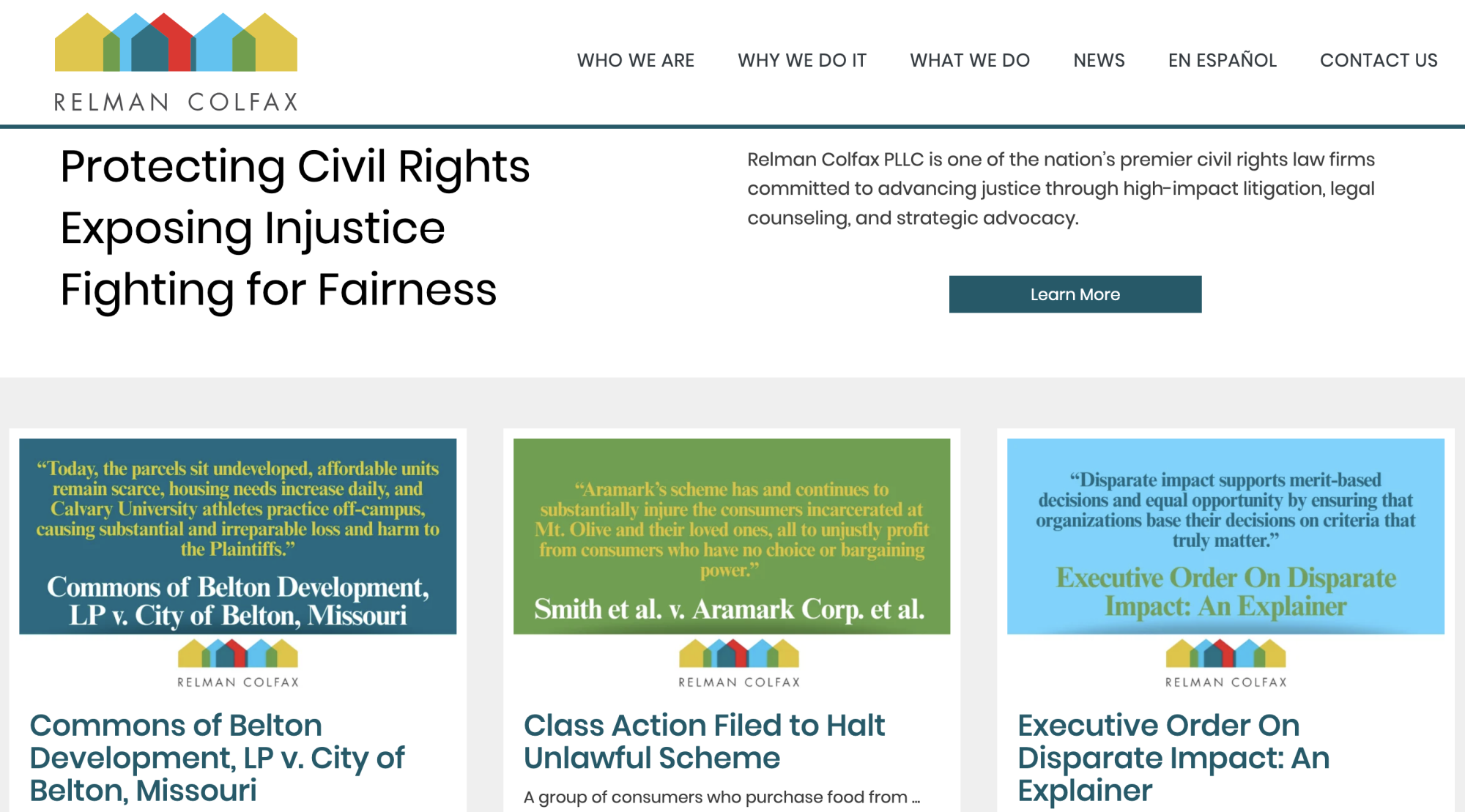
As new challenges to civil rights emerge daily, we redesigned our homepage to serve as a clear, reliable resource for you. Our updated website highlights not only the most pressing developments, but also the victories and forward momentum that remind us why this work matters.
Built with our community in mind, the updated site is designed to be visited often, bringing timely updates on cases, commentary, news, and key wins directly to you. We’re excited to share these new features and invite you to check back regularly as our work continues to unfold.
Closing Thoughts
As we close out this year, we do so with inspiration from Dr. Martin Luther King Jr., who reminded us, "If you can't fly then run, if you can't run then walk, if you can't walk then crawl, but whatever you do you have to keep moving forward."
We take those words to heart and we are deeply grateful to each of you who continue to move alongside us on this path towards progress. Justice does not come only in sweeping victories, it is also built through daily action, persistence, and the willingness to keep going and speak out in the toughest of times. Together, step by step, we move closer to the future we know is possible. We look forward to continuing on this journey towards justice with you in 2026 and beyond.